

Community health workers
The community health worker (CHW) programme extends BridgeERP HMS out of the facility and into households. Community health volunteers, promoters and extension workers register the households in their catchment, conduct monthly and sick-child visits, raise referrals into the facility, and report their activity each month. It is built for African primary care — iCCM sick-child care, MCH follow-up, MUAC nutrition screening and the MoH 514-style community register — with a data shape designed for lightweight mobile and USSD field capture.
Where to find it
The programme lives under Public Health → CHW Programme:
- Public Health → CHW Programme → Households — the catchment register (model hms.chw.household).
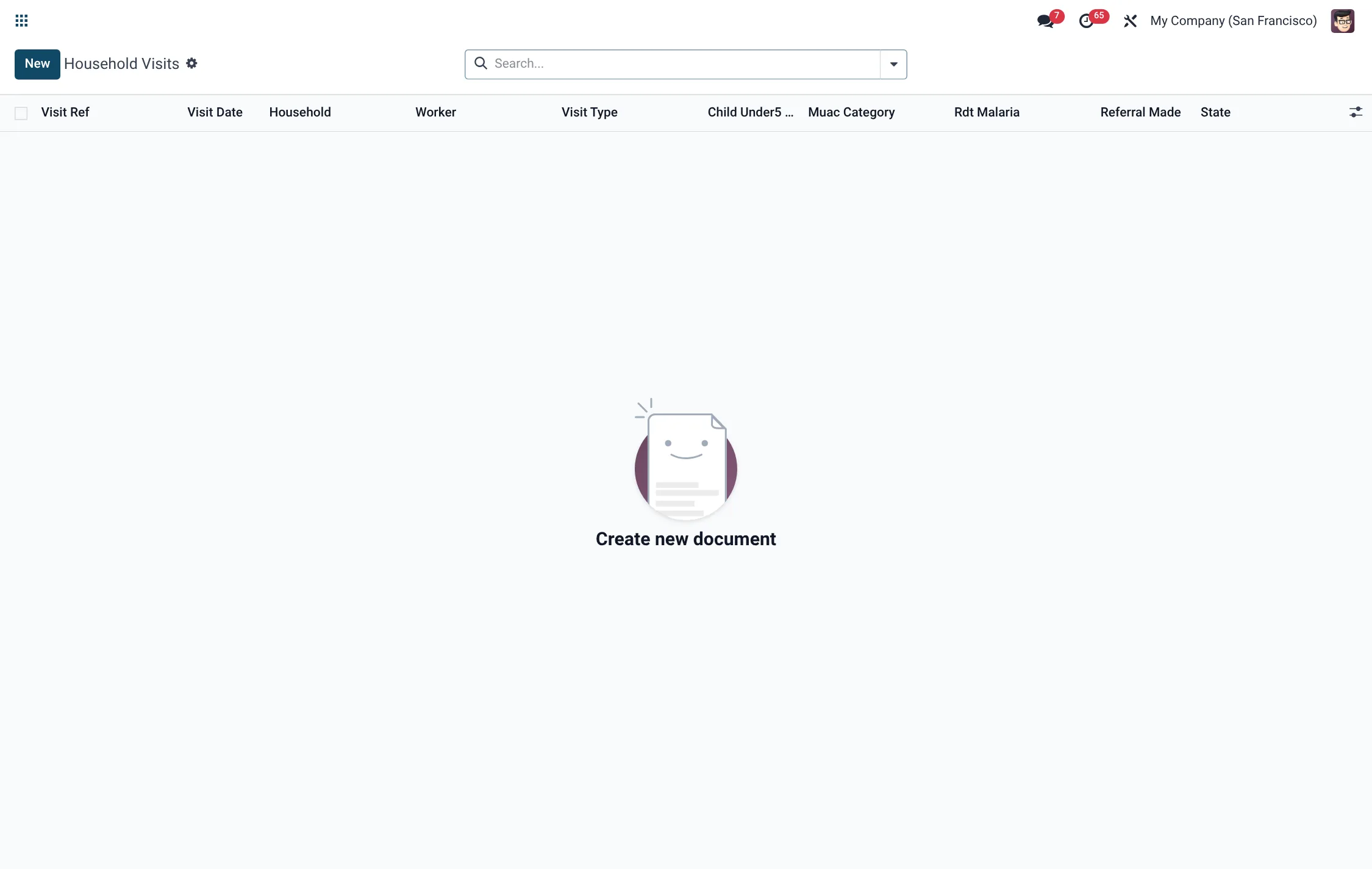
- Public Health → CHW Programme → Visits — household visits (hms.chw.visit).
- Public Health → CHW Programme → Referrals — referrals to the facility (hms.chw.referral).
- Public Health → CHW Programme → Monthly Summaries (MoH 514) — the community activity return (hms.chw.monthly.summary).
- Public Health → CHW Programme → Configuration → CHWs / Promoters — the worker registry (hms.chw.worker).
- Public Health → CHW Programme → Configuration → Community Health Units — the CHU structure (hms.chw.unit).
Before you start
Set up the community structure first. Under Configuration → Community Health Units create your CHUs, then under Configuration → CHWs / Promoters register each worker with their code, phone, role (Community Health Volunteer, Community Health Promoter, Community Health Worker, Community Health Extension Worker or Traditional Birth Attendant), unit and supervisor. Record whether a bicycle or smartphone has been provided and what training the worker has received. Households are then registered against a unit, so visits and summaries roll up correctly.
Register a household
- Open Public Health → CHW Programme → Households and create a record.
- Enter the code, head of household, phone and address, and link the community health unit.
- Record the house type (Permanent, Semi-Permanent or Temporary) and the WASH indicators — has toilet/latrine, safe water source, handwash station, and whether the household sleeps under an ITN.
- Add household members so individuals can be the subject of visits and referrals.
Conduct a household visit
- Create a visit under Visits, selecting the household and worker; a visit reference is generated.
- Choose the visit type: Routine Monthly, iCCM Sick-Child, MCH ANC Follow-up, MCH PNC / Newborn, Immunization Defaulter Follow-up, TB DOTS, HIV Adherence or Chronic Disease Follow-up.
- For a sick child, record the MUAC measurement — the system classifies it Green (≥125 mm), Yellow (115–124 mm, MAM) or Red (<115 mm, SAM) — and the iCCM signs (cough/difficulty breathing, diarrhoea, fever, multiple).
- Record any malaria RDT result and the commodities given: ORS, Zinc, Amoxicillin DT, AL/ACT.
- If the child needs facility care, tick Referral Made and raise a referral (see below).
- Set the visit Status to Completed when done.
Raise a referral
- Create a referral under Referrals (or from a visit), naming the patient, age and sex.
- Choose the reason — e.g. Severe Acute Malnutrition, Severe Pneumonia, Diarrhoea with Dehydration, Severe Malaria, general IMCI danger signs, ANC, Skilled Delivery or PNC.
- Set the severity: Routine, Urgent or Emergency, and the facility referred to; note whether transport was arranged.
- When the patient is seen, set arrival confirmed and the outcome (Seen & Treated, Admitted, Counter-Referred Back to CHU, Did Not Attend or Died); record any counter-referral note.
- Move the referral state from Draft to Referred and finally Closed.
Visit field reference
| Field | Meaning | Required |
|---|---|---|
| Household | The household being visited | Yes |
| Worker | The CHW conducting the visit | Yes |
| Visit Type | Routine, iCCM, MCH, defaulter, TB, HIV, chronic | Yes |
| MUAC / Category | Mid-upper-arm circumference and its Green/Yellow/Red band | For child visits |
| iCCM Signs | Danger signs assessed | For sick-child |
| Commodities | ORS, Zinc, Amoxicillin DT, AL/ACT given | As applicable |
| Status | Draft, Completed, Cancelled | Yes |
Monthly summary (MoH 514)
Each worker's activity rolls into a Monthly Summary under CHW Programme → Monthly Summaries (MoH 514), keyed by worker, month and year and grouped by community health unit. This is the community register that aggregates visits, screenings and referrals for the period — the figures your facility carries into MoH community reporting.
Mobile & field use
The CHW data model is deliberately lean — coded selection fields, simple counts and yes/no indicators — so that visit and referral records can be captured on low-bandwidth mobile and USSD channels in the field. Workers flagged as smartphone provided are your candidates for app-assisted capture; the rest can be supported through paper-to-clerk entry against the same records.
Roles & access
Three groups govern the programme: CHW Worker (records their own households, visits and referrals), CHW Supervisor (oversees a unit, reviews referrals and monthly summaries) and CHW Coordinator (programme-wide configuration of units and workers).
How the CHW programme links to the facility
The community programme is most valuable when it closes loops with the rest of the suite rather than sitting apart. An immunisation defaulter traced by Community Health Worker Referral becomes a household-level task; a sick child found with danger signs on a visit becomes a facility referral that the receiving clinic acts on; and a counter-referral sends the clinic's follow-up instructions back to the worker who first found the case. In this way a single child can move from a CHW's MUAC screen, to an emergency referral, to facility care, and back to community follow-up — all tracked against the same shared patient and household. The monthly summary then aggregates this activity into the community register the facility carries into Ministry of Health reporting, so the work done at the doorstep is visible in the official numbers.
Tips & troubleshooting
CHW roles & household fields
Workers are registered with a role, and each household carries WASH and nutrition indicators that drive community reporting.
| Worker role | Meaning |
|---|---|
| Community Health Volunteer | Volunteer member of the community health unit |
| Community Health Promoter (paid stipend) | Stipended promoter |
| Community Health Worker (clinical) | Clinically trained worker |
| Community Health Extension Worker | Extension-cadre worker |
| Traditional Birth Attendant | TBA linked to the unit |
| Household field | Captures |
|---|---|
| House type | Permanent, Semi-Permanent, Temporary |
| Has Toilet/Latrine | WASH indicator |
| Has Safe Water Source | WASH indicator |
| Has Handwash Station | WASH indicator |
| Sleeps Under ITN | Malaria-prevention indicator |
Visit type catalogue
The visit type sets what is captured and which programme the visit feeds.
| Visit type | Used for |
|---|---|
| Routine Monthly | Standard household visit |
| iCCM Sick-Child | Integrated community case management of a sick child |
| MCH ANC Follow-up | Antenatal follow-up |
| MCH PNC / Newborn | Postnatal and newborn care |
| Immunization Defaulter Follow-up | Tracing a missed-dose child |
| TB DOTS | Community directly-observed treatment |
| HIV Adherence | Adherence support |
| Chronic Disease Follow-up | NCD follow-up |
| Contact Tracing | Tracing contacts of a case |
| Outbreak Response | Activity during an outbreak |
| Health Promotion | Education and promotion |
| Referral Follow-up | Following up a prior referral |
Referral reason, severity & outcome
| Field | Values |
|---|---|
| Reason | Severe Acute Malnutrition, Severe Pneumonia, Diarrhoea with Dehydration, Severe Malaria, General Danger Signs (IMCI), ANC, Skilled Delivery, PNC, Immunization, HIV Test/Treatment, TB Screening, Chronic Disease Review, Other |
| Severity | Routine, Urgent, Emergency |
| Outcome | Seen & Treated, Admitted, Counter-Referred Back to CHU, Did Not Attend, Died, Pending |
| State | Draft → Referred → Closed |
CHW Programme menus at a glance
| Menu path | Opens | Model |
|---|---|---|
| Public Health → CHW Programme → Households | Catchment register | hms.chw.household |
| Public Health → CHW Programme → Visits | Household visits | hms.chw.visit |
| Public Health → CHW Programme → Referrals | Facility referrals | hms.chw.referral |
| Public Health → CHW Programme → Monthly Summaries (MoH 514) | Community return | hms.chw.monthly.summary |
| Public Health → CHW Programme → Configuration → CHWs / Promoters | Worker registry | hms.chw.worker |
| Public Health → CHW Programme → Configuration → Community Health Units | CHU structure | hms.chw.unit |