

Quality & Governance
Quality & Governance is the institutional safety and improvement hub of BridgeERP HMS. It brings patient-safety incidents, infection prevention and control, accreditation standards, audits, corrective actions and quality indicators into one place so that a hospital can demonstrate — to its board, to regulators and to surveyors — that care is safe, monitored and continuously improving. It is used by quality officers and managers, infection-control teams, committee chairs and clinical leaders.
Where to find it
Everything in this area sits under the top-level Quality & Governance application.
- Quality & Governance → Dashboard and Quality Dashboard — the safety and KPI cockpits.
- Quality & Governance → Incidents & Risk — the patient-safety incident register, with Incident Reports, Action Plans, Committee Reviews and the Board Dashboard (see the Incidents page).
- Quality & Governance → Audits, Findings and CAPAs — accreditation surveys, their findings and corrective/preventive actions.
- Quality & Governance → KPI Library and Measurements — the catalogue of quality indicators and their recorded values.
- Quality & Governance → Policies — controlled policy documents.
- Quality & Governance → Committee Meetings and Committee Actions — governance committee records.
- Quality & Governance → HAI Surveillance, Outbreaks, Hand Hygiene Audits, Isolation Patients, MDRO Surveillance, Antimicrobial Stewardship and the Epidemiology Dashboard — the infection prevention and control workstream.
- Quality & Governance → Sentinel Events, RCA Workspace, Patient Complaints and Compliments — serious-event and patient-experience handling.
- Quality & Governance → Configuration — Standards, Contributing Factors, Organisms, Control Measures, Susceptibility Library, SLA Escalation Rules, Alert Subscriptions and Settings.
The four pillars
1. Incidents & risk
Any member of staff can report a patient-safety event — a medication error, a fall, a device problem, a near miss. Each report is risk-scored and worked through investigation, root-cause analysis and corrective action to closure and board reporting. This is the most-used part of the area and is documented in full on the Incidents page.
2. Infection prevention & control
The infection-control workstream runs healthcare-associated infection (HAI) surveillance, manages outbreaks, audits hand hygiene, tracks isolation patients and multidrug-resistant organisms (MDRO), and supports antimicrobial stewardship. Configuration master data — Organisms, Control Measures and the Susceptibility Library — underpins this surveillance, and the Epidemiology Dashboard visualises trends.
3. Accreditation, standards & audits
Audits are planned and run against accreditation Standards. An audit record carries its type — Internal Audit, External Audit, Mock JCI Survey, Mock NABH Survey, SafeCare Survey, Mock ISQua Survey, Regulatory (MoH) or Peer Review — and moves through Planned → In Progress → Draft Report → Final Report → Closed. Each gap becomes a Finding, and each finding drives a corrective action.
4. CAPA & quality measurement
Corrective and Preventive Actions (CAPAs) turn findings and incidents into tracked improvement work, progressing through Draft → In Progress → Awaiting Verification → Effectiveness Check → Closed (with an Escaped outcome where an action did not hold). The KPI Library defines the hospital's quality indicators and Measurements records their values over time for the Quality Dashboard.
Audit & CAPA workflow
Accreditation readiness is a continuous loop, not a once-a-year scramble. The two registers that drive it are Audits and CAPAs.
- Plan an audit under Quality & Governance → Audits: choose the audit type, name the lead auditor, set the audit date and link the accreditation Standards being assessed. The audit starts Planned.
- Move it to In Progress as the survey runs, recording each gap as a Finding under Quality & Governance → Findings.
- Produce a Draft Report, then a Final Report with the overall score, and Close the audit once findings are assigned.
- Each significant finding spawns a CAPA. Work it from Draft to In Progress, then to Awaiting Verification and Effectiveness Check before Closed. Mark a CAPA Escaped if a verified action later failed to hold.
| Audit type | Purpose |
|---|---|
| Internal Audit / Peer Review | Routine self-assessment by the hospital's own teams. |
| External Audit / Regulatory (MoH) | Assessment by an outside body or the Ministry of Health. |
| Mock JCI / Mock NABH / Mock ISQua / SafeCare Survey | Practice runs against named accreditation frameworks ahead of the real survey. |
Audit lifecycle & findings
An audit moves through a fixed status track, and every gap it raises becomes a graded finding.
| Audit status | Finding severity |
|---|---|
| Planned | Observation |
| In Progress | Minor Non-Conformity |
| Draft Report | Major Non-Conformity |
| Final Report | Critical Non-Conformity |
| Closed | Best Practice |
A finding tracks its own status — Open → CAPA Assigned → Closed — as corrective action is attached and completed.
CAPA statuses
Corrective and Preventive Actions turn findings and incidents into tracked improvement work.
| CAPA status | Meaning |
|---|---|
| Draft | Action drafted, not yet started. |
| In Progress | Action being implemented. |
| Awaiting Verification | Implemented; awaiting check that it was done. |
| Effectiveness Check | Being watched to confirm the fix held. |
| Closed | Verified effective and signed off. |
| Escaped | A verified action later failed to hold. |
Accreditation bodies & KPI categories
Standards are filed against an accrediting body, and each quality indicator in the KPI Library belongs to a category with an improvement direction.
| Accreditation body | KPI category |
|---|---|
| JCI (Joint Commission International) | Clinical Quality |
| NABH (India) | Patient Safety |
| SafeCare (Africa) / COHSASA (Southern Africa) | Access & Throughput |
| ISQua | Efficiency |
| ISO 15189 (Lab) / ISO 9001 | Financial |
| CAP (College of American Pathologists) | Patient Satisfaction |
| Local MoH | Staff / Workforce |
A KPI's direction is either Higher is Better or Lower is Better, and its reporting frequency is Daily, Weekly, Monthly, Quarterly or Annually.
Committees & infection control
Governance meetings are typed by committee, and the infection-prevention workstream tracks healthcare-associated infections (HAI) by type.
| Committee type | HAI surveillance type |
|---|---|
| Medical Executive Committee (MEC) | CAUTI — Catheter-Associated UTI |
| Infection Control Committee | CLABSI — Central Line Bloodstream Infection |
| Morbidity & Mortality (M&M) | SSI — Surgical Site Infection |
| Quality Assurance / Performance Improvement | VAP — Ventilator-Associated Pneumonia |
| Credentialing & Privileging | CDI — C. difficile Infection |
| Ethics Committee / Research (IRB) | MRSA Bacteraemia / VRE / ESBL / CRE |
| Board of Directors / Quality Board | Other MDRO |
Isolation precautions are typed Contact, Droplet, Airborne, Contact + Droplet, Contact + Airborne, Neutropenic / Protective or Enteric, each with its own active / completed lifecycle.
How it fits together
- A problem enters as an incident, an audit finding, an infection signal or a patient complaint.
- Serious events are escalated as Sentinel Events and investigated in the RCA Workspace.
- Root causes generate CAPAs and Action Plans with owners and due dates.
- Governance committees review the evidence, and trends surface on the Quality Dashboard and Board Dashboard.
Roles & access
| Role | What they do |
|---|---|
| Quality & Governance / User | Reports incidents and feedback; reads dashboards relevant to their work. |
| Quality & Governance / Quality Officer | Runs audits, manages CAPAs and KPI measurements, coordinates infection control. |
| Quality & Governance / Quality Manager | Owns standards, committees and board-level reporting. |
| Incident Reporter / Investigator / Committee | Tiered access to the confidential incident register (see Incidents). |
Reports & dashboards
The area produces the Quality Dashboard (KPI trends from Measurements), the incident Board Dashboard, the Epidemiology Dashboard for infection surveillance, audit Findings summaries, CAPA status, and the metrics that support accreditation surveys and board governance.
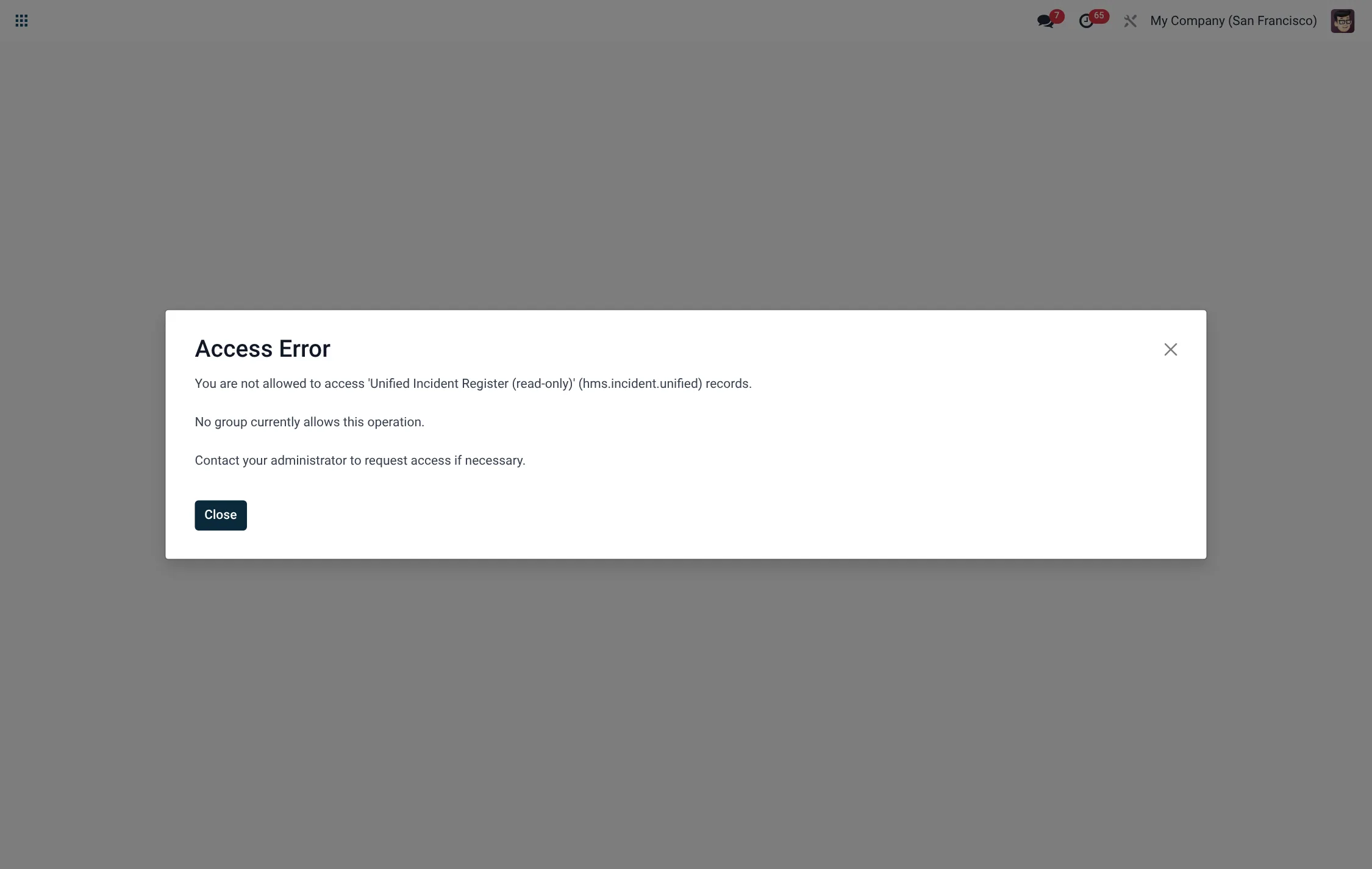
Tips & troubleshooting
Related
- Incident register — report, investigate (RCA/CAPA), close and report to the board.
- Theatre — surgical outcomes and complications that feed quality review.