

CSSD — sterile supply
The Central Sterile Supply Department (CSSD) in BridgeERP HMS reprocesses every surgical instrument so the operating room always receives sterile, traceable sets. The module tracks instrument trays and loose instruments through the full reprocessing loop — decontamination, assembly, packaging, sterilisation and release — logs each sterilisation cycle with its chemical and biological indicators, and records where every sterile set was used. If a load fails, CSSD drives the recall of affected trays. It is operated by CSSD technicians, supervisors and managers.
Where to find it
CSSD lives under HMS Core → Theatre.
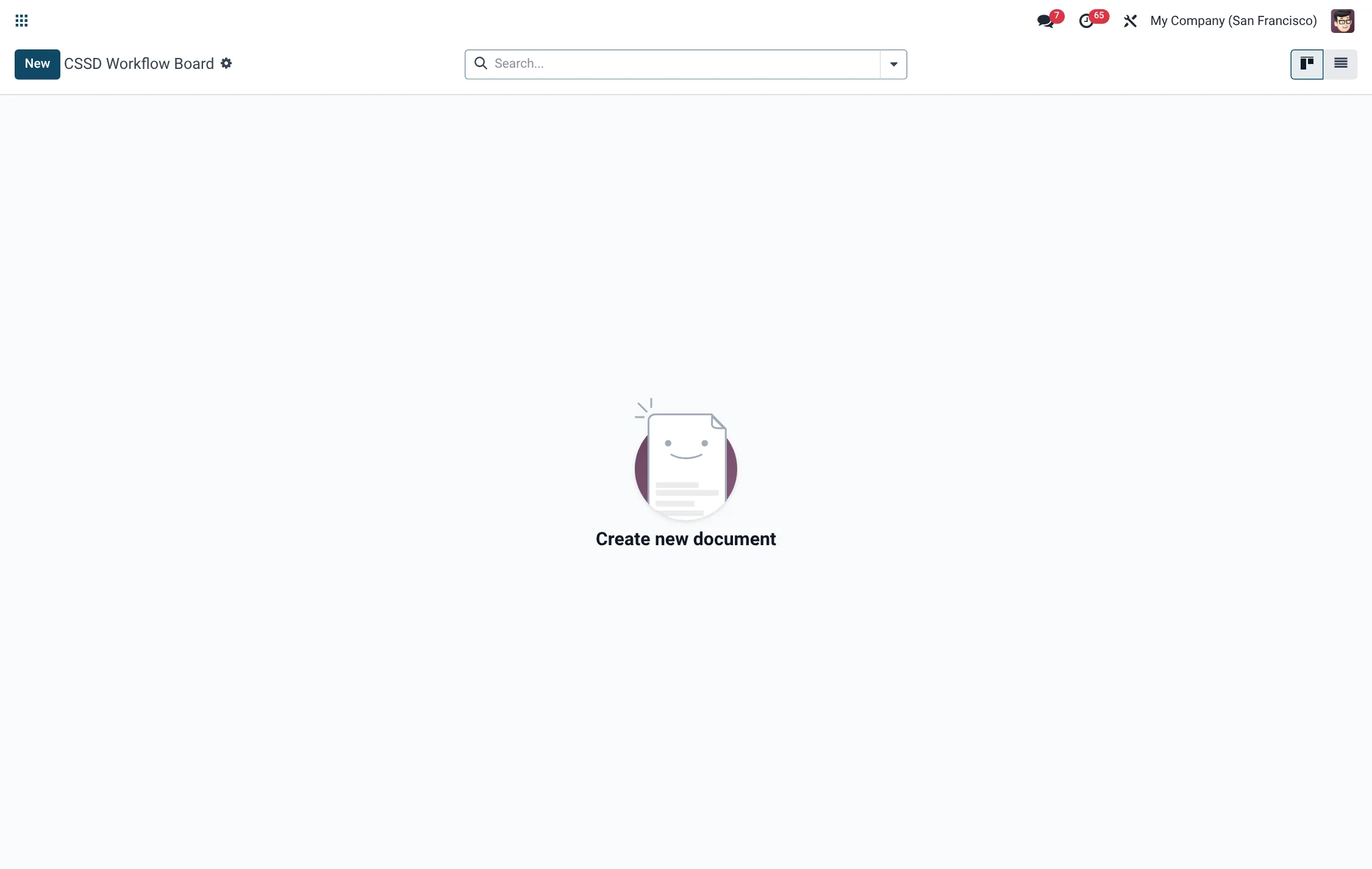
- HMS Core → Theatre → Workflow Board — a board of trays grouped by their current reprocessing stage.
- HMS Core → Theatre → Instrument Trays and Loose Instruments — the tray and instrument registers.
- HMS Core → Theatre → Sterilization Cycles — the log of every sterilizer load.
- HMS Core → Theatre → Biological Indicators — BI test results that confirm a load was truly sterilised.
- HMS Core → Theatre → Usage Events — the record of which sterile tray was used on which case.
- HMS Core → Theatre → Recalls and Repair Tickets — failure handling and instrument repair.
- HMS Core → Theatre → Metrics — throughput and quality reporting.
- HMS Core → Theatre → Configuration — Sterilizers, Locations and Checklist Templates.
Before you start
Configure the department's master data first, under HMS Core → Theatre → Configuration:
- Sterilizers — register each steam autoclave, EtO, hydrogen-peroxide plasma or ozone unit. Cycles are logged against a sterilizer, and its state (idle / in use) updates as cycles run.
- Locations — define the decontamination, assembly, packaging, sterile-store and theatre locations trays move between.
- Checklist Templates — standard assembly/inspection checklists for tray make-up.
- Instrument Trays and Loose Instruments — create each tray with its code, type, specialty and wrapping type so it can be tracked.
The tray reprocessing loop
Every tray moves through a defined lifecycle, visible on the Workflow Board. The tray states are: In Use - Theatre → Contaminated - Returned to Decon → In Decontamination → In Assembly / Inspection → In Packaging → In Sterilization → Ready for Use - Sterile, with side states for Expired - Re-sterilize and Lost / Damaged.
- After a case, press Return Contaminated (or Mark Returned) to bring the used tray back; it becomes Contaminated - Returned to Decon.
- Press Send to Decon to move it into In Decontamination.
- Press Start Assembly to inspect and rebuild the set against its checklist; the tray is In Assembly / Inspection. Damaged items can be routed out with Send for Repair / Repair Needed.
- Move the assembled set into packaging, then press Send to Sterilization; the tray is In Sterilization and is included in a sterilizer load.
- Once the cycle is released, the tray becomes Ready for Use - Sterile and can be issued to the next case with Mark In Use.
Tray states
The Workflow Board groups trays by these states; the two side states sit outside the normal loop.
| Tray state | Meaning |
|---|---|
| In Use - Theatre | Issued to a case and in use. |
| Contaminated - Returned to Decon | Used tray returned, awaiting decontamination. |
| In Decontamination | Being washed / disinfected. |
| In Assembly / Inspection | Being inspected and rebuilt against its checklist. |
| In Packaging | Wrapped or containerised ready for sterilisation. |
| In Sterilization | Loaded in a sterilizer, awaiting cycle release. |
| Ready for Use - Sterile | Released and available to issue. |
| Expired - Re-sterilize | Past its wrapping shelf life; must be reprocessed. |
| Lost / Damaged | Out of circulation pending repair or write-off. |
| Tray specialty (type) | Wrapping type & shelf life |
|---|---|
| General Surgery / Orthopedic / Neurosurgery | Wrapped — 14 days. |
| Cardiothoracic / OB-Gyne / ENT | Peel Pouch — 30 days. |
| Ophthalmic / Dental / Plastic Surgery | Rigid Container with Dust Cover — 180 days. |
| Urology / Paediatric / Emergency | Flash / Immediate Use — use immediately. |
Sterilisation cycles
Each sterilizer load is recorded as a Sterilization Cycle with a cycle number, sterilizer, cycle type and indicator results. Cycle states are: In Progress → Completed - Pending BI → Released for Use, with Failed and Voided outcomes.
- Start the load; the cycle is In Progress and the sterilizer is marked in use.
- Press Complete Cycle when the machine finishes; the cycle moves to Completed - Pending BI and the trays move to In Sterilization pending verification.
- Record the biological indicator. On a pass, Release for Use sets the cycle to Released for Use and its trays to Ready for Use - Sterile.
- On a BI fail or a Bowie-Dick fail, use Fail & Recall; the cycle becomes Failed and a recall is initiated for the affected trays.
Sterilisation cycle states
Each load moves through these states; the release status mirrors them for trays held pending BI.
| Cycle state | Meaning |
|---|---|
| In Progress | The sterilizer is running; the unit is marked in use. |
| Completed - Pending BI | Machine finished; trays held until the biological indicator reads out. |
| Released for Use | BI passed; trays released as sterile. |
| Failed | BI or Bowie-Dick failed; a recall is initiated for affected trays. |
| Voided | Cycle abandoned / invalidated. |
Cycle types & indicators
| Cycle type | Use |
|---|---|
| Steam 134C / 3.5 min (Flash / Immediate Use) | Immediate-use reprocessing of a single item. |
| Steam 134C / 5 min Pre-vacuum | Routine wrapped instrument loads. |
| Steam 121C / 30 min Gravity | Gravity-displacement loads. |
| Ethylene Oxide | Heat-sensitive items. |
| Hydrogen Peroxide Plasma (Sterrad) | Heat- and moisture-sensitive devices. |
| Ozone / Peracetic Acid | Low-temperature alternatives. |
Chemical indicators run from Class 1 (process) through Class 6 (emulating); the Bowie-Dick test (Class 2) checks air removal in pre-vacuum steam sterilizers and is recorded as Pass, Fail or Not Applicable.
| Chemical-indicator class | What it verifies |
|---|---|
| Class 1 — Process Indicator | Item was exposed to the process (distinguishes processed from unprocessed). |
| Class 2 — Specific Test (Bowie-Dick) | Air removal / steam penetration in pre-vacuum sterilizers. |
| Class 3 — Single Variable | Reacts to one critical variable (e.g. temperature). |
| Class 4 — Multi-Variable | Reacts to two or more critical variables. |
| Class 5 — Integrating | Reacts to all critical variables across the cycle. |
| Class 6 — Emulating | Cycle-specific; reacts to all variables of a named cycle. |
The biological indicator (BI) is the definitive proof of sterility, read out by visual colour change, fluorescence (rapid readout) or ATP bioluminescence:
| BI result | Meaning & action |
|---|---|
| Pending Incubation | Spores incubating; trays held. |
| Negative - Pass | No spore growth; load may be released. |
| Positive - Fail (Spore Growth) | Sterilisation failed; recall the affected load, take the sterilizer offline and investigate root cause. |
| Indeterminate / Repeat | Inconclusive; retest the cycle. |
Traceability & recalls
Traceability is the heart of CSSD. Each tray carries a wrapping type that fixes its sterile shelf life — Wrapped (14 days), Peel Pouch (30 days), Rigid Container with Dust Cover (180 days) or Flash / Immediate Use. Usage Events link a sterile tray to the case it was used on, and Sterilization Cycles link trays to their load. Together these give a two-way chain: from a patient back to the cycle, and from a failed cycle forward to every tray and patient affected. When a cycle fails, the Recalls register tracks the investigation through to Close Recall; Repair Tickets handle instruments that need servicing.
| Recall state | Repair-ticket state |
|---|---|
| Initiated | Open |
| Contained (affected trays flagged Expired - Re-sterilize) | In Progress |
| Investigation Complete | Completed |
| Closed | Instrument Replaced |
| – | Written Off |
Repair tickets also carry an urgency (Routine, Urgent, Immediate), a repair type (sharpening, polishing, ratchet or hinge repair, jaw or blade replacement, total replacement, other) and an assignee (In-House Workshop or External Vendor).
Roles & access
| Role | Responsibility |
|---|---|
| BridgeERP HMS / CSSD Technician | Runs the day-to-day reprocessing loop — decontamination, assembly, packaging, sterilisation. |
| BridgeERP HMS / CSSD Supervisor | Releases cycles, oversees BI verification and recalls. |
| BridgeERP HMS / CSSD Manager | Manages master data, metrics and departmental governance. |
Record rules limit CSSD locations, sterilizers, instruments, trays and cycles to a user's own facility.
Tips & troubleshooting
Related
- Theatre overview — the surgical pathway CSSD supplies.
- Scheduling — booking the cases that consume sterile sets.
- Quality & Governance — where a sterilisation failure may be raised as an incident.