

Repricing Gap
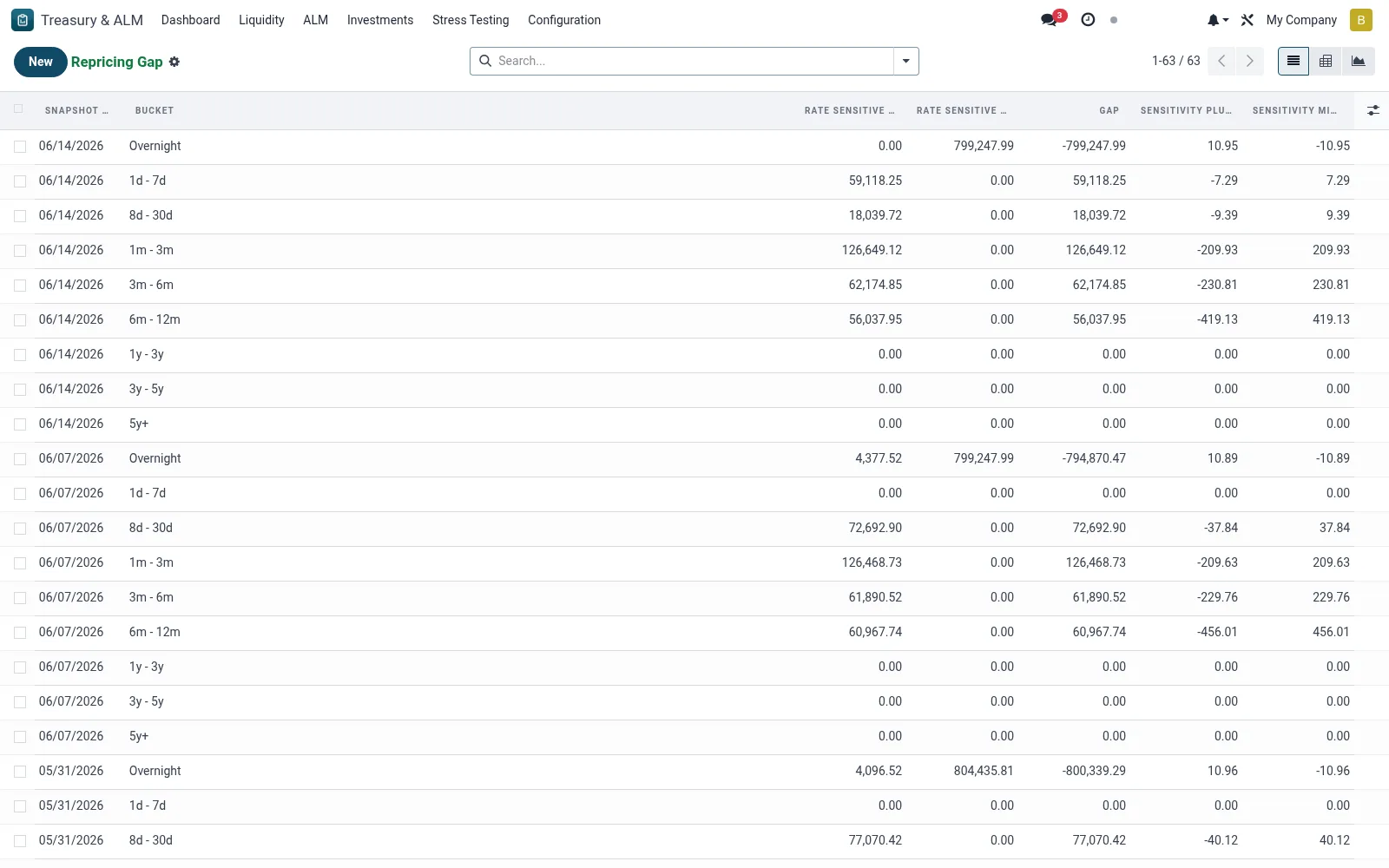
Repricing Gap reports the difference between rate-sensitive assets and rate-sensitive liabilities falling due in each time bucket, quantifying interest-rate risk in the banking book. Positive and negative gaps show whether the SACCO gains or loses as rates move. Pivot and graph views present the gap ladder and cumulative position for management and regulatory review.
Workflow
- Open Treasury & ALM then ALM then Repricing Gap.
- Generate the report for the reporting date using current positions.
- Review the gap in each maturity bucket and the cumulative gap.
- Use the graph to visualise the gap ladder across buckets.
- Assess whether the net position sits within the board's rate-risk limits.
Fields reference
Every field on this screen, drawn from the live data model.
| Field | Type | Required | Description |
|---|---|---|---|
Snapshot Datesnapshot_date | Date | Yes | Snapshot Date |
Bucketbucket_id | Link → treasury.bucket | Yes | Bucket |
Has Messagehas_message | Yes/No | — | Has Message |
Namename | Text | — | Name |
Rate Sensitive Assetsrate_sensitive_assets | Money | — | Rate Sensitive Assets |
Rate Sensitive Liabilitiesrate_sensitive_liabilities | Money | — | Rate Sensitive Liabilities |
Gapgap | Money | — | Gap |
Cumulative Gapcumulative_gap | Money | — | Cumulative Gap |
Sensitivity Plus 100Bpssensitivity_plus_100bps | Money | — | Sensitivity Plus 100Bps |
Sensitivity Minus 100Bpssensitivity_minus_100bps | Money | — | Sensitivity Minus 100Bps |
Sensitivity Plus 200Bpssensitivity_plus_200bps | Money | — | Sensitivity Plus 200Bps |
Sensitivity Minus 200Bpssensitivity_minus_200bps | Money | — | Sensitivity Minus 200Bps |
Companycompany_id | Link → res.company | — | Company |
Currencycurrency_id | Link → res.currency | — | Currency |
Notes & rules
- Gap per bucket equals rate-sensitive assets minus rate-sensitive liabilities.
- Cumulative gap shows the net repricing exposure up to each horizon.
- A large negative gap implies exposure to rising rates and vice versa.
- Bucket boundaries are defined in the maturity-bucket configuration.
Was this page helpful?