

CBET / TVET
For vocational and technical institutions, EduPrime supports Competency-Based Education & Training: map national occupational standards, assess learners against competencies rather than exams, and issue competency certificates.
Mapping occupational standards
CBET starts from the national qualification, not from a syllabus of subjects. Under CBET → Occupational Standards, build the qualification hierarchy:
- Qualification – the award (e.g. “Plumbing Level 5”) aligned to the national framework.
- Units of competency – the building blocks, each a discrete skill area, marked core or elective.
- Elements & performance criteria – the observable, assessable statements inside each unit.
EduPrime mirrors the structure published by the national qualifications authority, so the competencies a learner is assessed on match exactly what the regulator expects to see on a certificate.
Assessing by competency
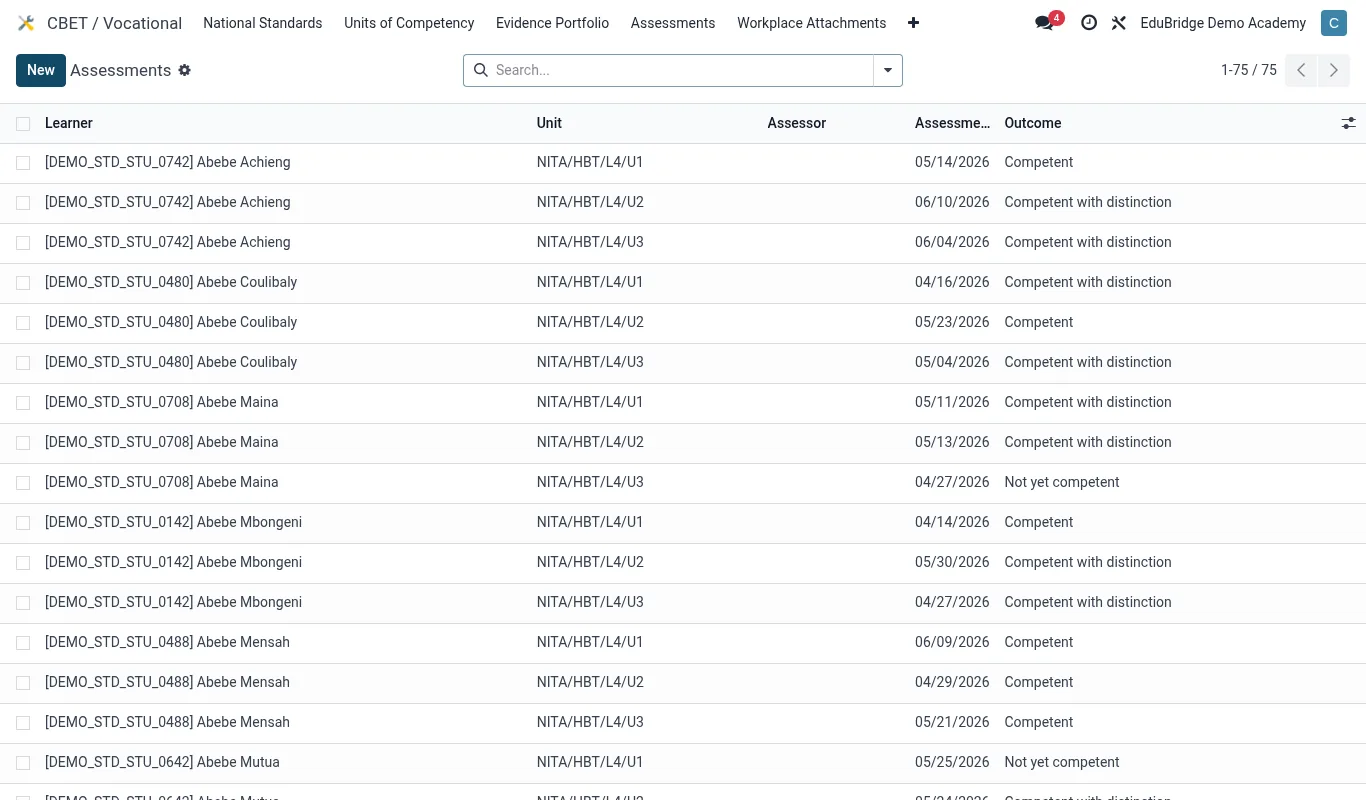
CBET grading is binary at the criterion level: a learner is Competent (C) or Not Yet Competent (NYC) – there is no percentage. Assessment is evidence-driven:
- The assessor opens the learner’s competency matrix for a unit.
- For each performance criterion, the assessor records the verdict and attaches evidence – an observation, a portfolio item, a workplace report, a practical task.
- A unit is awarded once all its criteria are judged Competent.
- An internal verifier samples and confirms assessment decisions; an external verifier from the regulator may moderate before certification.
Competency certificates
When a learner achieves all core units (and any required electives) for a qualification, EduPrime makes them eligible for the competency certificate. The certificate lists the qualification, the units of competency achieved, and a verification code. A statement of attainment can be issued for partial completion – the specific units a learner has achieved without the full qualification.
Because CBET learners are people records like any other, their certificates, attachments and placement history (see Industry attachment & placement) live together – giving a complete competency profile per learner.