

Bria — AI early warning
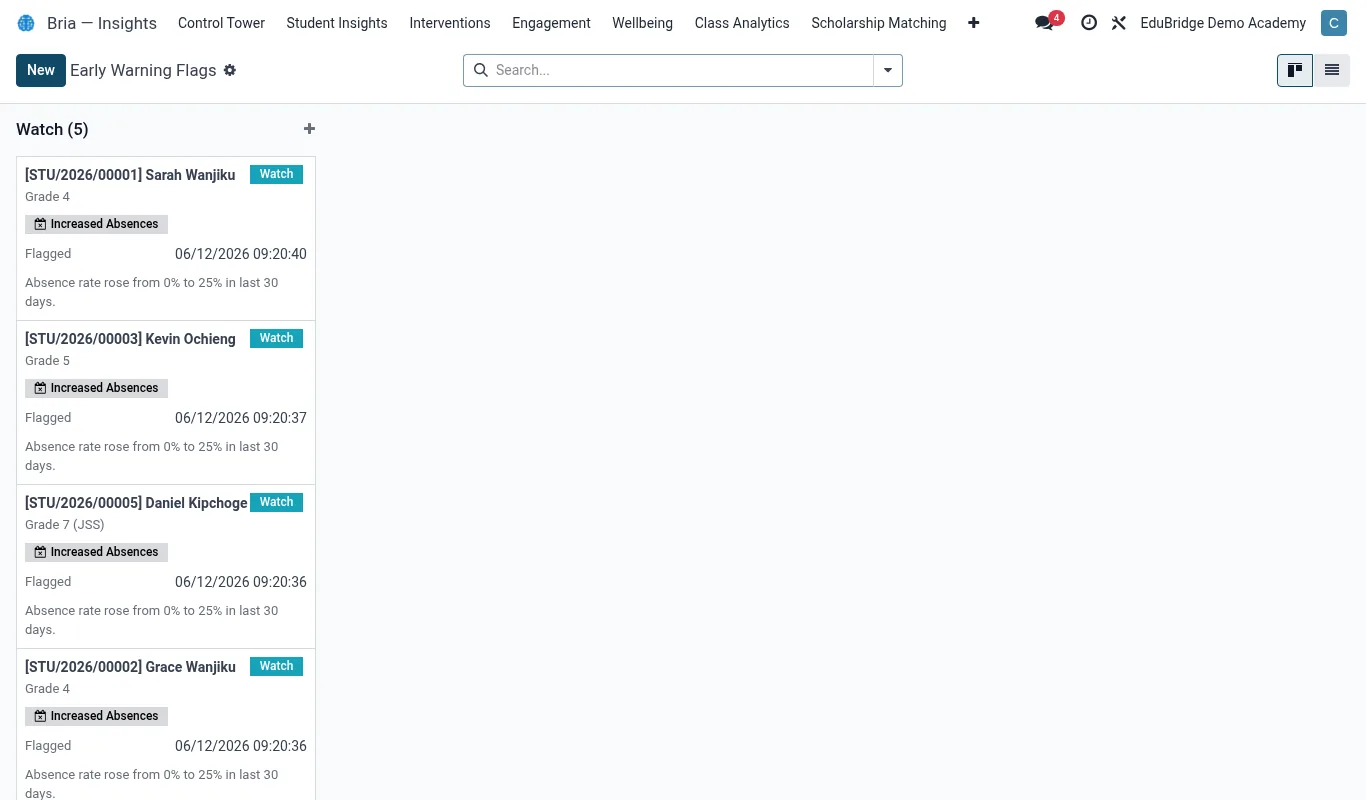
Bria is EduPrime’s AI early-warning system. It combines attendance, grades, fee status and welfare signals into a single risk score, surfaces the students most likely to fall behind or drop out, and tracks the interventions you take – closing the loop.
How the risk score is built
Bria reads signals that already live in EduPrime – it invents no new data entry. The risk score is a weighted blend of four signal groups:
| Signal group | Examples Bria reads |
|---|---|
| Attendance | Falling attendance rate, recent unexplained absences, lateness trend |
| Grades | Declining marks, failed assessments, GPA/CGPA drop, missed submissions |
| Fee status | Outstanding balance, broken payment plan, finance holds |
| Welfare | Disciplinary flags, counselling referrals, health or hostel incidents |
Each student receives a score and a band – typically low, medium or high risk. The score is a relative early warning, not a verdict: it tells staff where to look first, sorted so the most concerning students rise to the top.
The at-risk list
The Bria dashboard presents the at-risk list – students ranked by score, filterable by class, cohort, programme or band. For each student you can open a risk profile that explains why they are flagged: the specific attendance dip, the failed unit, the unpaid balance. Transparency matters – staff act on reasons, not on a black-box number.
The intervention loop
An early-warning system is only useful if warnings lead to action. Bria tracks interventions end-to-end:
- Flag – a student rises into the medium/high band.
- Assign – a staff member (class teacher, dean, counsellor) is given the case.
- Act – an intervention is logged: a parent meeting, a counselling session, a fee-plan arrangement, tutoring.
- Review – the intervention’s effect is checked at a follow-up date; the case is updated.
- Close – when the student’s signals recover, the case is closed with an outcome recorded.
Because every intervention is logged against the student, the institution builds an evidence base of what works – and can show inspectors, boards or parents that flags were not just raised but acted upon.